CRIME ON THE COSTAS
Disclaimer: The statements and articles listed here, and any opinions, are those of the writers alone, and neither are opinions of nor reflect the views of this Blog. Aggregated content created by others is the sole responsibility of the writers and its accuracy and completeness are not endorsed or guaranteed. This goes for all those links, too: Blogs have no control over the information you access via such links, does not endorse that information, cannot guarantee the accuracy of the information provided or any analysis based thereon, and shall not be responsible for it or for the consequences of your use of that information.
CRIME ON THE COSTAS is pleased to provide this opportunity to share information, experiences and observations about what's in the news. We encourage lively, open debate on the issues of the day, and ask that you refrain from profanity, hate speech, personal comments and remarks that are off point. Thank you for taking the time to offer your thoughts.

BREAKING NEWS

Monday, 16 January 2012

British driver arrested after Sevilla hit and run

Posted On 23:39 0 comments


23 year old Briton has been arrested in Campillos, Málaga, by the Guardia Civil in connection with a hit and run accident at a petrol station in Gillena Sevilla last Thursday. A petrol station worker was injured and had to be admitted to the Virgen del Rocio Hospital, and the driver failed to stop. The Briton lives in Campillos and has been named with the initials W.A.F., and has been taken to Sevilla to attend the court which has charge of the case. By chance a member of the public had seen a TV report on the wanted driver and recognised him coincidentally at a petrol station in Campillos.


Bad news for foreign victims of Costa del Sol mortgage scam

Posted On 23:36 0 comments


The National Court will not be investigating the mortgage fraud which was reported last year by twenty foreign residents of the Costa del Sol and which affected victims all along the Spanish coastline. Most of the banks and foreign financial advisors involved were from Denmark who informed their clients that, if they died without a mortgage on their Spanish property, their heirs would be subject to hefty inheritance taxes which they would never be able to pay. They were then offered a mortgage on their property, with the money invested outside Spain, mainly in Luxembourg. El Mundo reports that the investments did not however go well, and the victims are now in danger of losing their homes. The Málaga victims are represented by the Marbella law firm Lawbird, who told El Mundo, ‘This is complete judicial apathy from this court, which considers the complaint as lacking in relevance.’ ‘It contrasts,’ they said, ‘with the rapid response from the Danish government which has announced that it will investigate the manoeuvres which invested the funds from the loans in fiscal paradises.’


Court orders Spanish woman to return her children to her husband in the UK

Posted On 23:33 0 comments


Spanish woman resident in Valencia, named by EFE as Carolina A.G., has been ordered by a local court to return her children to their father in the UK, where the family moved in 2008. Her estranged husband is a Nigerian man who obtained Spanish nationality after they married in Spain in 2003. The couple has three children, now aged 8 and 5 years old and, the youngest, just 4 months. Their mother says she has suffered abuse from her husband throughout her marriage, and she finally reported the abuse last year. She also reported him for rape. She told the EFE news agency, ‘I feared for mine and my children’s lives … he has also mistreated the eldest and he even punched me in the stomach when I was pregnant with my last child.’ She decided to return to Spain after he threatened to take the children to Nigeria and she was advised by the Spanish Consulate in Nottingham that it was better for her children to be in Spain. The mother does not have sole custody, and a Valencia court applied the Hague Convention in its ruling made public on Monday, considering to be responsible for illegal abduction. It also said that she has violated an order from a Nottingham court banning her from taking two of her children outside the jurisdiction of England and Wales. The denuncias against the husband were not taken into account by the Valencia court and the mother’s lawyer has now requested a letter rogatory to the UK justice system for the official complaints to be provided to Spain. It’s understood that he has also lodged a denuncia for rape and abuse at the National Court, as the body which is responsible for safeguarding the rights of any Spanish citizen.


Sunday, 15 January 2012

Spanish tourism received a welcome boost last week with UK travel agents reporting a rise in interest and bookings to the country.

Posted On 16:23 0 comments


Spanish tourism received a welcome boost last week with UK travel agents reporting a rise in interest and bookings to the country. The news came when on Friday the Post Office revealed evidence that resort prices have crashed by as much as 40% compared to 5 years ago. That, combined with political unrest in some other popular tourist destinations and the fact that the pound is at a 2 year high against the euro has once again made Spain an affordable and favourite option. The annual survey conducted by the Post Office measured the prices of 8 items in resorts across 33 destinations around the world. Those items included a cup of coffee in a bar or café; a bottle of local beer; a 1.5 litre bottle of water from a supermarket; a can of Coca-Cola; a three course evening meal for two adults; sunscreen; insect repellent and a pack of cigarettes. The results of the survey showed that Spain came out the second cheapest with an average price of £37.72 for the 8 items. It was topped only by Sri Lanka offering the best value at £27.95. With people looking for a cheap way to enjoy fun in the sun and the Post Office currently offering a currency rate of 1.165€ to the pound (prices correct as of Friday 13th Jan.) it is thought a new wave of visitors will be enjoying the delights of Spain this year with the firm’s Holiday Money Report concluding: ‘Resort prices in the Costa del Sol are now 40% lower than 5 years ago, when we conducted the first price barometer. The cheaper cost of travel to Spain will make it a compelling choice for bargain hunters. So does the rising value of the UK pound - up 6.4% against the euro in the past three months.’ Turkey has in recent years been a serious rival to Spain's top status for bargain breaks but this year it proved to be 60% more expensive than Spain. This year, Turkey was17th in terms of the cheapest option according to the Post Office survey. At the other end of the scale the survey showed Australia to be the most expensive country for the 8 items at a staggering £115.69, together with Barbados, Singapore and New Zealand. The biggest rises were recorded in Kenya, where the basket was 52% more expensive than last year and Portugal, where the increase was 39%.


Crash and burn time for Spain's crusading judge?

Posted On 15:13 0 comments


He indicted late Chilean dictator Augusto Pinochet on genocide charges and became an instant hero to many around the world. A decade later he launched a similar crimes-against-humanity probe over atrocities by the right-wing victors of Spain's Civil War. Now Judge Baltasar Garzon is finding himself in the dock. On Tuesday, Garzon goes on trial for allegedly ordering illegal jailhouse wiretaps in a domestic corruption probe. A week later he appears in court to face charges he overstepped his authority in the Civil War case. Supporters say he's the victim of a witchhunt by courthouse colleagues jealous of his fame and of arch-conservatives angered by his attempt to revisit Spain's war-time past. Whatever the motivations, Spain's once high-flying but now-suspended super sleuth may be about to crash and burn definitively. Garzon doesn't face jail time if convicted in either trial. But he can be removed from the bench for up to 20 years, which at his age — 56 — would in effect end his career as an investigating magistrate at the National Court. The judge — who also charged Osama bin Laden and probed abuses at the United States' Guantanamo Bay prison for terror suspects — is separately under investigation over his dealings with a big Spanish bank. Garzon's lawyer says the precedent set by the trials, plus the probe which could lead to a third trial, will make it virtually impossible for Garzon to take up his post again even if he is acquitted in all three cases. "Judge Garzon is facing the perfect storm," said the attorney, Gonzalo Martinez-Fresneda. New York-based Human Rights Watch said the fact that Garzon was even charged for probing killings and forced disappearances by supporters of Gen. Francisco Franco during and after the 1936-39 war is an outrage. The group's spokesman, Reed Brody, said it is already discouraging judges in other countries from applying the principles of law he championed. Both sides in the Spanish war — the Republican side and Franco's rebel right-wing forces — committed atrocities. But they were addressed by a post-Franco-era amnesty approved by Parliament. Republican atrocities against pro-Franco civilians had already been thoroughly documented by the regime. The specific charge against Garzon is that he knowingly overstepped the bounds of his jurisdiction with his unprecedented albeit abortive probe of crimes committed by the Franco side. Garzon, a workaholic from a modest background in Spain's olive-growing south, certainly never expected to find himself in court as a criminal suspect. Rights advocates in Spain and abroad adore him for his pioneering cross-border justice cases, which apply the principle of universal jurisdiction — the idea that some crimes are so heinous they can be prosecuted anywhere, not just in the country where they are alleged to have been committed. Since Garzon had Pinochet arrested in London in 1998 in an ultimately failed bid to put him on trial in Madrid, Garzon and colleagues at the National Court have issued indictments and arrest warrants over crimes in such far-flung places as Tibet and Rwanda. The effect here in Spain has been largely symbolic. There's been only one conviction — that of an Argentine 'dirty war' suspect who came to Spain voluntarily to testify and ended up charged and convicted in 2005. And there has been one extradition. But the arrest of Pinochet inspired victims of abuses, especially in Latin American countries like Argentina, Chile and Guatemala, to challenge and win the repeal of laws giving amnesty to perpetrators of atrocities committed by military juntas, said Brody. "Garzon changed the world," he said. Spain's decision to put Garzon on trial before the Supreme Court, he added, "leaves Spain open to the charge of double standards: they are willing to work for justice in so many other countries and yet at home they have problems with a judge who seeks justice."


3 ETA suspects arrested in France

Posted On 15:08 0 comments


French police acting alongside Spanish counterparts have arrested three men at a railway station in France on suspicion of belonging to Basque separatist group ETA, the Interior Ministry said Sunday. One of those arrested in Joigny, 150 kilometers (93 miles) southeast of Paris, was identified as 33-year-old Jon Echeverria Oyarbide, for whom there is an international arrest warrant. Police said he was in possession of material used in the manufacture of explosives. Echevarria was found in possession of bomb-making materials. The others were identified as Ruben Rivero Campo, who is wanted for "an election offense" and Inigo Sancho Marco, who is not on a wanted list, the ministry said in a statement, adding the arrests took place Saturday afternoon. The statement said officers had spotted Echeverria at Bercy railway station in Paris and tailed him covertly to Joigny, where an apparent rendezvous with the other men took place. The men were armed and police found a car with false license plates in the station car park in Joigny. The arrests occurred a day after Spain's Interior Minister, Jorge Fernandez, insisted that as long as ETA existed its members would be hunted down. Spanish state broadcaster TVE said the three were being held at Auxerre police station awaiting transport to Paris. ETA has killed 829 people since the late 1960s in bombings and shootings aiming to force the creation of a Basque homeland in northern Spain and southwestern France. It is classified as a terrorist organization by Spain, the United States and the European Union. Waves of arrests in recent years have repeatedly weakened ETA's structure and diminished its ability to perform acts of terror or collect funds.


Anthony Read was found dead in the sea in the port town of Puerto De La Duquesa

Posted On 11:25 0 comments

Anthony Read was found dead in the sea in the port town of Puerto De La Duquesa – on the country’s Costa del Sol – the morning after a night out drinking with friends in March last year.

Yesterday, at an inquest, mum and dad Jacqueline Jenkins and Martin Read criticised the investigation into the tragedy carried out by the authorities in Spain.

Anthony, 33,  had visited a number of pubs during the evening and took a taxi back to a pal’s home ten minutes’ drive away in the early hours.

But it is thought he may not have had the correct fare when he arrived and was driven back to the port, between Marbella and Gibraltar. Hours later, his body was found in the water.

Spanish authorities said there had been no signs of violence and that Anthony had drowned, concluding that the death may have been the result of an accident.

But at the inquest in Portsmouth, Anthony’s mother Jacqueline Jenkins hit out at the “vague” report drawn up by local officials as she attempted to piece together what had happened.

Dad Martin Read told the inquest he wanted confirmation from Spanish police that they were satisfied the taxi driver had driven away and was not involved in the tragedy. The inquest also heard how Anthony may simply have fallen in.

However, it remains unclear as to how he came to be in the water.

Coroner David Horsley said it was unlikely Anthony had been robbed as he was still in possession of his wallet and mobile phone when his body was discovered.

But he agreed that he had been faced with a lack of evidence in preparing the inquest.

He told Anthony’s parents: “It is possible that he fell in by accident but I cannot say that that is the most likely scenario because it is possible that he was pushed in – it may have been some kind of simple assault or he may have been trying to evade an assault.”

He added: “If there were any witnesses they did not come forward – or were they asked?”

Mrs Jenkins broke down in tears as she read out tributes to her “kind, thoughtful and wonderful son”, who was working as a financial controller in Gibraltar and was enjoying living in Spain.

In the run-up to his death, Anthony had been studying to become a chartered accountant.

Mr Horsley recorded an open verdict.


Days of the Costa del Crime could soon be over

Posted On 11:16 0 comments


THE days of the Costa del Crime could be seriously numbered. Or at least, so say the Spanish police. Detectives in Malaga have revealed that a year-long crackdown on British and Irish fugitives is paying off and Malaga is no longer an ideal hideout for wanted criminals. The clampdown, which came in a series of on-the-spot raids on pubs, bars and shops on the Costa del Sol, has drawn considerable success. In total, dozens of wanted fugitives have been caught in the raids after six roving teams of national police were set up at the end of 2010. The teams entered establishments closing off exits and demanded identification from all those present. In one day alone, last year, they made a staggering four arrests, while in total 117 Irishmen were arrested last year, using the method. The moves were spurred on by the murder of Irish tourist John O’Neill, 40, who was shot near a pub in Benalmadena by a man wanted by British police. Police insist that due to the crackdown there were fewer gangland shootings and ‘settling of accounts’ last year. “The recession could also have had an influence but things are definitely a lot quieter,” said a spokesman for the UDYCO organised crime unit.


Saturday, 14 January 2012

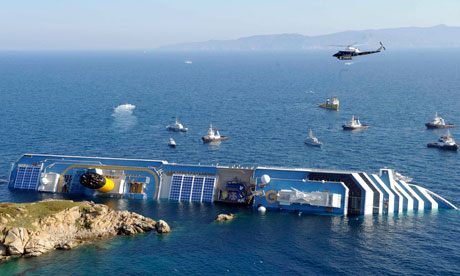
The Italian captain of a ship that sank off the coast of Tuscany was placed under arrest after one of the most dramatic holiday cruise disasters

Posted On 20:45 0 comments

A cruise ship that ran aground is seen off the west coast of Italy at Giglio island
The Costa Concordia lies on its side after running aground off the west coast of Italy at Giglio island. Photograph: Reuters

The Italian captain of a ship that sank off the coast of Tuscany was placed under arrest after one of the most dramatic holiday cruise disasters ever seen in the Mediterranean. Three passengers died and 69 were still unaccounted for after the 114,000-tonne Costa Concordia smashed into rocks amid scenes of panic and chaos.

Local prosecutors said Francesco Schettino was being investigated for manslaughter and abandoning ship following reports his stricken vessel failed to raise a mayday alert as the disaster unfolded.

There was speculation that a power failure on board the ship could have led to it losing navigational control and crashing into the rocks. Experts said that passenger reports of a power blackout and large blast indicated the vessel could have suffered an explosion in the engine room.

As the ship came to rest half submerged on its side, yards from the coast of the island of Giglio late on Friday, anger rose among the thousands of passengers who had swum or been ferried and flown to safety over what they described as a botched evacuation by crew members who panicked.

Italian police confirmed that two French tourists and a Peruvian crew member drowned in the accident. About 30 people were reported injured, with three critically hurt.

A British embassy official said not all the Britons on board the vessel had yet been accounted for. He said consular officials had so far confirmed that "around 20" survived.

Survivors described extraordinary scenes of panic, confusion and fear as the ship tilted on its side following what sounded like a loud explosion. Kirsty Cook, one of eight British dancers working on the cruise, said she was "lucky to be alive" after using a rope ladder to climb down to a waiting rescue boat. Another dancer, Rosie Metcalf, 22, from Dorset, had to cling to a fire hose before being winched to safety by a helicopter crew.

The Costa Concordia, which was built in Italy and launched in 2006, set off from Civitavecchia on Friday for a Mediterranean cruise, carrying 3,206 passengers and 1,023 crew. As the ship slid between Giglio and the coast, passengers sitting down for their first dinner on board felt a shudder before the lights went out.


Iberia pilots announce more strike action

Posted On 16:33 0 comments


Pilots from the SEPLA union who work for Iberia have announced three more days of strike action on January 25, 27 and 30. It follows four days of previous action in protest at the plans by Iberia to establish a new low-cost carrier, Iberia Express. SEPLA say that they have picked the dates with care, so as not to affect the Spanish tourism fair, FITUR, which runs in Madrid between the 18th and 22nd of this month. Meanwhile cabin crew and ground staff are also considering taking action, and are reported to be looking at striking on Mondays and Fridays from February 2. A meeting will be held on Tuesday to confirm that action which could affect 21,000 workers on the ground in handling, cargo, maintenance, trade and operational activities.


The Decree to regularize houses in Andalucia

Posted On 16:30 0 comments


According to Hillen “It’s possible that this fireworks display will dazzle some but if you look at the detail of the Decree you will see that it does not help those with ongoing court proceedings, where perhaps the majority could face the chop”. “If what the Junta wants is more cases like the Priors, the decree certainly does nothing to prevent that” she added. “Actually, I sometimes despair at how little the administration is in contact with the real problems of its citizens. They must know that what looks nice on paper is not always workable in practice. It appears that they don’t and all they want to do is inundate us with a byzantine tangle of laws and, whilst they are about it, completely destroy foreign investment in Spain”. Hillen asks “What shall I tell elderly retirees who have demolition orders against their homes? Can I tell them that the Decree will save them? I can’t because it doesn’t”. “What can I say to hundreds of retired couples who live on irregular urbanisations without escritura for their land? Can I tell them that the Decree will give them their escritura? No I can’t, and indeed some of those who currently have escritura are at risk because, according to the Decree, escrituras can be annulled because of the possible illegal segregation of land.” “On the other hand, the regularization of these developments still has to go through an unrealistic, expensive, arduous and painful process which will take a very long time” she added. Regarding the new provision for isolated houses she states that “I regret to say that these houses are relatively blighted, since according to the decree they are not entitled to a licence of occupation or use; are subject to yet to be defined future regulations and some theoretical minimum standard of habitability; Furthermore, the decree states that these houses can only be repaired and preserved; that they should have self sufficient supplies of water, electricity and waste treatment and that only in exceptional circumstances can they be connected to mains services; In other words they are of dubious legality” “That is to say that the Junta, instead of making an important legal change , and by that I mean changing the LOUA, to resolve a major problem has instead only created more confusion in addition to creating a category of second class housing”. She concluded by saying “I hope that not too many people are lured by this bait because I think that it doesn’t fix very much. In fact among our members we think that only 16% of them will benefit in any way from this Decree”.


Government to bring in changes to the 'Ley de Costas'

Posted On 16:26 0 comments


The current and controversial ‘Ley de Costas’ has been in force since 1988 with hardly any modifications. Now the new Minister for Agriculture, Foodstuffs and the Environment, Miguel Arias Cañete, has indicated that ‘very deep reforms’ are on the way to bring value to the coast. El País reoprts that at an event to welcome top civil servants in his department, he gave a speech which indicated that the environment cannot stop economic development, and said that environmental legislation needs to be simplified. Sources at the ministry have noted that there is a problem of judicial insecurity with the current legislation and that they have received pressure from countries such as Britain and Germany, and complaints from EuroMPs as there are foreigners who have been affected by the compulsory purchase aspect of the legislation. The law, which was left untouched by the Aznar government, declares all the beach to be of public use, but does not use a fixed distance, following geographic concepts instead. That extends the area into dunes and marshlands, to where the sea has reached in the worst of storms. Many people have purchased property without the notary or the bank telling them it is located in land for public use, and these people have been granted a 30 year concession of use, but no longer own the property. A legal change now is complicated by the fact that there has already been compulsory purchases and demolition of some properties, so their owners will now be able to claim compensation. The new legislation is expected to extend the concessions, as ‘thousands’ of them were to expire in 2018.


Thursday, 12 January 2012

Two air passengers met by police over heated bust up after teenager 'reclined his seat'

Posted On 12:44 0 comments


A furious row broke out between two passengers on a packed jumbo jet after one reclined his seat as the man behind was about to eat. The pair almost came to blows at 40,000ft as shocked travellers looked on. It started when an 18-year-old sitting in economy class moved his seat back to sleep. Air rage: The drama happened on board an Emirates 517-seat Airbus A380 - the world's biggest commercial airliner - from Dubai into Manchester Airport The 38-year-old passenger sitting immediately behind him was about to eat his in-flight meal at the time. And when he asked the youth to put his seat back up while he ate a major row broke out.   More... Airline passenger is stunned three times with a Taser gun after after he refuses screening check and runs into secure area Car-sized robotic explorer fires its thrusters for next stage of journey to Mars - and will land there in August The pair traded insults and leapt up from their seats in a head-to-head confrontation. As the argument became more heated cabin crew were called and attempted to defuse the incident. Stunned travellers watched as the two men continued to shout abuse at each other while standing in the aisle before they were finally persuaded to calm down. The drama happened on board a 517-seat Airbus A380 - the world’s biggest commercial airliner - operated by Emirates from Dubai into Manchester Airport. Close: The row broke out as one passenger reclined his seat while the man behind was about to eat The pilot of flight EK17 was so concerned he radioed ahead and police were informed. Officers went to the gate at Terminal 1 after the flight landed to meet the two passengers at around noon on Tuesday. A spokesman for Greater Manchester Police confirmed officers ‘spoke to’ two men, aged 38 and 18. No further action was taken as neither man wanted to make a formal complaint, and both also admitted they had been ‘in the wrong’, say police. A spokesman for the airline said: ‘Emirates does not tolerate this kind of behaviour from passengers and safety will not be compromised.’ They confirmed there had been an ‘altercation’ on board the flight and, although no blow had been exchanged, cabin crew had been called to calm the passengers. One traveller who uses the route said: ‘I have recently flown with Emirates to the Far East. This trip was split into two separate flights and lasted 20 hours. ‘Like a lot of people on the second leg of the trip I wanted to sleep. There is a system in place where you can indicate that you do not want the meal and to be left alone to sleep, which is what I did. My seat was reclined to the limit allowed. Welcome party: Police officers were waiting at the gate at Manchester Airport's Terminal 1, pictured, to meet the two passengers involved ‘When it came time for the meal I was woken up by the person behind asking me to sit up, so they could enjoy their meal. I was a little p***** off that I had been woken up. 'I hadn’t reclined it whilst he was eating, I was doing what I wanted to do, sleep, in a position that the seat was allowing me. I didn’t make a fuss and accepted it.’ He said: ‘This is only a problem in the "cheap" seats and perhaps the airlines can have an area in this class for passengers who want to sleep in the reclined position. 'No meals would be served to these passengers, so the problem will be removed. By sitting in this area you accept no meals and the seat in front may be reclined.’ The double-decker plane first started flying into Manchester Airport in September 2010 after around £10m had been spent on changes to the airfield to accommodate it. Its introduction was part of a huge boom in the number of people flying in and out of Dubai,


Gold treasure trove and millions in cash seized from Colombian drug dealers in Spain

Posted On 12:28 0 comments


A National Police operation has seized more than 4 million € in cash and a treasure trove of gold ingots from a group of drug traffickers based in the north west of Madrid which was finalising a deal to sell off half a ton of cocaine. Three suspects from Colombia have been arrested, who also face charges of money laundering. The Interior Ministry said in a press release on Tuesday that the drugs were brought into Spain by air and the laundered proceeds from their sale were then sent to Colombia in the same way. Police began their investigations last month and swooped on the luxury apartments which were used by the gang early on the morning of January 5, seizing more than 3.5 million € and three kilos of highly pure gold. The gold was made up of ingots each weighing a quarter of a kilo. A further half a million € was discovered when the suspects’ vehicles were searched.


Suspect arrested over woman found murdered in Fuengirola

Posted On 12:22 0 comments


An arrest has been made in the case of the woman who was found dead, wrapped in plastic and a blanket, beneath a bridge in Los Boliches, Fuengirola, on Monday morning. She was identified as E.U.G, a woman who was born in Almería in 1980. She is believed to have been killed last Saturday, two days before her body was found. The autopsy has now confirmed the cause of death as asphyxiation, and it’s understood there were also signs that she had been hit on the head. There was no sign of rape, or that any of her personal possessions had been stolen. All that’s known on the suspect is that he was known to the victim. La Opinión de Málaga said he was arrested in Fuengirola.


AIFOS boss now admits paying Juan Antonio Roca

Posted On 12:17 0 comments


Another twist in the Malaya case with the owner of the real estate promoter, AIFOS, Jesús Ruiz Casado, telling the court on Wednesday that, despite his declaration on Tuesday that he had never made any payments to the Marbella Municipal Real Estate Assessor, Juan Antonio Roca, that in fact he did make the payment ‘of some amounts’ through his commercial director, Francisco García Lebrón. Casado explained that he had found a 135,000 € mismatch in a report on the accounts of his company which had been presented to the Court, and that there was a 90,000 € coincidence with the notes in the computer archives of Juan Antonio Roca. He said he told his commercial director to make a payment to support the Town Hall sponsorships and fiestas. ‘I did not control this matter sufficiently’, he said and said he pleaded guilty to avoid prison, and admitted making payments of 4.8 million € for town planning favours between 2004 and 2006, for which he is accused.


Tuesday, 10 January 2012

the secret of the Costa del Sol got out to the world, in a big, big way

Posted On 22:51 0 comments


.The mid-Andalusian coastline began to lure Northern European types, weary of their long, dark winters and eager to bask in the region's ever-present sunshine. First came the super-rich and famous (think Audrey Hepburn, Cary Grant, and Laurence Olivier), after Prince Alfonso of Hohenlohe-Langenburg opened the aristocratic Marbella Club in 1954. The demi-rich and B celebs followed, and gradually the masses—as is their wont—caught wind of the fun and sun, subsequently descending in droves. Through it all, the gays came too, establishing their beachhead at Torremolinos in the 1960s and 70s. Unfortunately, the switch from sleepy-fishing-village-dotted seashore to frolicksome touristic playground proved too rapid for the area to bear seamlessly. Unsavory types like on-the-lam Brits, the Russian mob, and Arab arms traffickers crept in, earning the region the unwelcome nickname Costa del Crime in the late 1990s and early 2000s. Unsavory Marbella politicians meanwhile took advantage of the instability, pushing through scores of corrupt construction projects before being stopped and ultimately jailed. Now, however, with a clean political slate and hot on the heels of a highly publicized summer 2010 visit to the area by Michelle Obama, the Costa del Sol is back with a vengeance. A new generation of hip tourists, a large faction of them gay, are now discovering the 300-plus days of sun, the warm Mediterranean beaches, the bargain-to-luxury shopping, the excellent spas, the delectable food, the rich history, the effervescent culture, and yes, those scrumptious southern Spanish men of the delightful Costa del Sol. By far, most international visits to the Costa del Sol start in Málaga, and more specifically at its Pablo Ruiz Picasso International Airport. Low-cost carriers like Ryanair and EasyJet have turned this into Spain's fourth busiest airfield, with scores of carriers now serving over 60 countries. The airport's newly opened third terminal is expected to accommodate the growing number of travelers in the coming years. Thanks to an extension of Spain's high-speed AVE train line in 2007, it's now also possible to get from Madrid to Málaga by rail in just about two and a half hours. While many Málaga arrivers scurry off to nearby beachside resort towns, any proper visit to the area requires a healthy dose of the beautiful city itself. With about 570,000 inhabitants, this is Europe's southernmost metropolis, not to mention one of the world's oldest towns, with an historical center dating back more than 3,000 years. In this now fully modern and vibrant city, remnants of previous civilizations are around every bend, with Phoenician, Roman, Moorish, and Reconquista Christian sites especially visible—and more still being found all the time. In 1951, during the construction of a new library, a fantastic first century B.C.E. Roman Theater was unearthed, and it's now one of Málaga's main attractions. More recently, during the construction of the Vincci Selección Posada del Patio Hotel on Pasillo Santa Isabel, remains of both the Roman and Arab walls of the city were found, and can be viewed by all from a specially designed underground walkway. THE INSIDERS GUIDE WHERE TO STAY WHERE TO PLAY WHERE TO EAT WHAT TO DO Pablo Picasso and Antonio Banderas are two of Málaga's most famous sons, and while you have a slight chance of seeing the latter on one of his frequent visits to town, you certainly won't miss homages to the former, known to his mother and many a modern tour guide as Pablo Diego José Francisco de Paula Juan Nepomuceno María de los Remedios Cipriano de la Santísima Trinidad Ruiz y Picasso. The fabulous Museo Picasso, while just one of three major museums devoted exclusively to the artist's work (the others are in Barcelona and Paris), contains perhaps the most intimate and revealing collection, with more than 220 works donated directly by Picasso's daughter-in-law and grandson. Also worth a visit is the Museo Casa Natal (Birthplace House Museum), which features thousands of works by Picasso, his contemporaries, and those he influenced. Just up the hill from the Roman Theater is the Alcazaba, a Moorish fort started in the eighth century but mostly taking its present form in the mid-11th century. Farther up the hill (but further forward in time) is the Castillo de Gibralfaro, where the Moorish people of Málaga famously waged a three-month battle (albeit ultimately unsuccessfully) against the Catholic monarchs, Ferdinand and Isabella, in 1487. Inside the castle is a small but interesting archaeological museum, but most visitors come for what's outdoors: breathtaking views of the city below. For a royal hotel stay, the Parador de Málaga Gibralfaro, part of Spain's exceptional state-owned Paradores system, is actually attached to the castle itself. Continuing onward chronologically, Málaga's post-Reconquista city center Cathedral is known locally as La Manquita, or "one-armed lady," thanks to her clearly missing second tower, a victim of depleted coffers in the 18th century. She's still stunning, and her one beautiful outstretched arm manages to crop up in photos all around the old town. CLICK FOR SLIDESHOW OF COSTA DEL SOL When you're ready for a break and some Málaga tapas, the nearby La Moraga is unparalleled, the local outpost of Michelin-starred chef Dani García's growing gastronomic family. Once sustained, try out Málaga's plentiful shopping options, especially the city center pedestrian street Calle Marqués de Larios, which is lined with chic shops, boutiques, and cafés. Málaga also has a Corte de Inglés (part of the much-beloved, Spanish, one-stop, department store chain), as well as several malls and countless specialty stores spread across the city. One of Málaga's most famed festivals is its vivid Holy Week (or Semana Santa), during which massive ornate tronos (thrones, or floats), made of gold and silver and often weighing more than five tons, are carried through the streets, accompanied by music and song. Things turn especially dramatic on Good Friday, when shops and streetlights go dark to better showcase the solemn procession. Antonio Banderas sometimes still takes part in the festivities, as he did here in his youth. The festival dates back more than 500 years to the Catholic Reconquista, and its long history is commemorated at the Museo de la Semana Santa (Holy Week Museum). Somewhat less holy but even more famous is the Feria de Málaga, a nine-day, mid-August festival that's one of Spain's largest. Shops and offices close so everyone can enjoy the food and drink. Meanwhile, traffic is stopped so the streets can fill with music and dancing. Traditional costumes are everywhere, with many women in colorful flamenco dresses and many men dressed as sexy vaqueros (or cowboys). While it's not nearly as big as Holy Week or Feria, Málaga has its own Pride event as well called Hoy Málaga es Gay (Today Málaga is Gay), taking place annually in late June. LGBT life is thriving in Málaga, which boasts a growing number and variety of gay bars and clubs, many situated around Plaza de la Merced. For a fun dip into the local queer scene, start out with the lively Bohemian loungy-ness of El Carmen, then move on to the throbbing disco action of Reinas (Queen). The refreshingly small (just 50 rooms) and colorful Room Mate Lola Hotel is a great place to lay your head in Málaga, with cool design, a central location, a hip clientele, and a friendly staff. Even more centrally located (right next to the Cathedral) is the AC Málaga Palacio Hotel, which boasts a rooftop pool and restaurant/bar with 360-degree views of the city, making it a consummate setting for that impromptu Spanish same-sex wedding. For venturing beyond Málaga proper and onward to the splendid Costa del Sol, your best bet is to rent a car. This can be ridiculously cheap, as low as $60 a week depending on when you travel, your vehicle preference, and Euro conversion rates. Taxis are plentiful, but distances between towns are fairly large, so fares can be high. Buses are available as well, but they run sporadically. Trains, running about every 30 minutes, also connect Málaga to Torremolinos and Fuengirola, but the latter is only about halfway to Marbella, so you'll still need a cab or car to take you the full distance there. Less than ten miles south of Málaga lies Torremolinos, long the gay capital of the Costa del Sol region. Though it began like many towns in the area as a sleepy fishing village, people were here and queer as early as the late 1950s. By 1962, Toni's Bar, Spain's first-ever gay bar, had opened. Even during the oppressive Franco regime, homosexuals were mostly given wide berth to behave as they liked in Torremolinos—as long as they spent their tourist pesetas while doing so. By the early 1970s, gay life was booming here, centered (as it still is) around La Nogalera in the heart of town. Torremolinos lost much of its cachet in the mid-70s when down-the-coast Marbella came into full bloom, but with the decriminalization of homosexuality in Spain later in the decade, the town began to attract more and more gays from all over the country, and eventually from across Europe. After an upswing in the 1980s and much of the 90s, another downturn followed just before the millennium, as Eurogays bored of a destination that'd become too routine and gone stale. Somewhat surprisingly, Torremolinos has undergone yet another powerful resurgence in the last few years, proving it a gay Spanish phoenix that simply refuses to go quietly. As Spain's magnetism draws in more and more international LGBT travelers, Torremolinos, virtually unknown to Amerigays until recently, is now finally being discovered by those looking beyond the tried and true Madrid-to-Barcelona-and-Sitges route. Interestingly, Torremolinos also draws many heterosexual Nordic and British types, leading to odd amalgams like a Finnish bar atop a gay disco, as in the case of the popular and very fun Home. Other current LGBT hotspots (among some 20 in Torremolinos) include Parthenon and Passion discos, both always packed on weekends. Since Torremolinos isn't yet exactly teeming with upscale lodging options, many visitors choose to stay in Málaga and make the journey by taxi at club time—in fact, it's what many Malagueños themselves do every weekend. For those who'd rather be able to stumble home, Hostal Guadalupe is a solid Torremolinos choice. Beyond the packed nightclubs and visible renovations around town, another clear indication that Torremolinos' star is again on the rise was the 2010 debut of Expo Gays, an international gay business expo that drew some 180 exhibitors and 15,000 visitors to the city's 60,000-square-foot Palace of Congresses and Exhibitions over three days in mid-October. Of course, one of the main reasons people flock to Costa del Sol is to soak up the ever-present local sun. Torremolinos itself has several lovely stretches of sand, including the once gay but now mixed Poseidon Beach. Most locals will assure you, however, that the best gay beach in Costa del Sol is farther down the coast, between Calahonda and Marbella at Cabopin. While this naturist beach isn't exclusively gay, it boasts a large pink stretch (commencing about 200 yards to the west of the parking lot) that includes a very cruisy and action-packed dune area. Whether you lay or play, Cabopin makes for a nice rejuvenating stop on the journey south from Torremolinos or Málaga to Marbella.


Undercover agents with the U.S. Drug Enforcement Administration, working with their Mexican counterparts, helped transfer millions of dollars in drug cash and even escorted a shipment of cocaine via Dallas to Spain

Posted On 22:45 0 comments


The covert activities were undertaken as part of an operation to infiltrate and prosecute a major Colombian-Mexican narco-trafficking organization moving cocaine from Colombia to Mexico and the United States. The undercover operation, detailed in Mexican government documents obtained by the New York Times, first came to light via a Monday dispatch by Times reporter Ginger Thompson. The documents "describe American counternarcotics agents, Mexican law enforcement officials and a Colombian informant working undercover together over several months in 2007," Thompson reported. "Together, they conducted numerous wire transfers of tens of thousands of dollars at a time, smuggled millions of dollars in bulk cash—and escorted at least one large shipment of cocaine from Ecuador to Dallas to Madrid." The documents "show that in 2007 the authorities infiltrated" the operations of an accused major Colombian cocaine trafficker, named Harold Mauricio Poveda-Ortega, Thompson wrote. Poveda-Ortega, also known as the Rabbit, "was considered the principal cocaine supplier to the Mexican drug cartel leader Arturo Beltran Leyva." Leyva was killed in 2008 in a shootout with Mexican naval forces. Poveda-Ortega was arrested in Mexico City in November 2010. The Mexican government documents include testimony from a DEA special agent "who oversaw a covert money laundering investigation" into Poveda-Ortega, Thompson reported. The documents form part of the file supporting a Mexican Foreign Ministry extradition order for Poveda-Ortega from last May 2011. The United States, however, has declined to indicate whether Poveda-Ortega was extradited to the United States, Thompson writes. A Justice Department spokeswoman Laura Sweeney similarly told Yahoo News Monday that the department is "not in a position to comment on the specific matter." The Drug Enforcement Administration defended the undercover operation in a written statement given to Thompson. "Transnational organized groups can be defeated only by transnational law enforcement cooperation," the agency wrote. "Such cooperation requires that law enforcement agencies — often from multiple countries — coordinate their activities, while at the same time always acting within their respective laws and authorities." Former DEA agent Robert Mazur, who posed as a money launderer in a similar undercover DEA investigation targeting the banks supporting the Medellin drug cartel, said such undercover operations are necessary and legitimate. Covert drug stings are critical, he says, in lining up evidence to successfully prosecute the top command and control figures of organized crime cartels. "This is a law enforcement technique that has been used for decades," Mazur told Yahoo News in a telephone interview Monday. "If we were to embrace the concept that these undercover money laundering operations shouldn't be conducted because in a small way, they for a brief period of time create a short term benefit for the criminal, we would be doing criminal organizations around the world the greatest favor they could get. We would be closing door to one of the most effective methods available to attack what law enforcement calls the command and control of these global organizations." The organizations targeted in these intricate DEA stings "are not people selling dime bags of crack on the street, but people trying to create terrorists states around the world," continued Mazur (Mazur, who retired from the DEA in 1998, has recounted his experience infiltrating the BCCI bank accused of money laundering for the Colombian drug cartel, in a book, The Infiltrator.) Mazur also disputed any comparison between the undercover DEA case exposed by the Times Monday and the recent controversy over "Fast and Furious," the Bureau of Alcohol, Tobacco and Firearms (ATF) program that allegedly put guns in the hands of Mexican drug gangs. "I would never agree in any circumstances it's worthwhile to put 2,000 weapons in the hands of criminals," he said. "Each of these operations needs to be professionally managed and individually scrutinized. This one, from what I read, is very common place, and I don't see anything in there that disturbs me in the least." Recent DEA undercover operations have led to the apprehension and successful prosecution of two major global arms traffickers, including the Russian-born, so-called "merchant of death" Viktor Bout, who was convicted in November on four counts of plotting to sell anti-aircraft guns and other weapons to Colombia's FARC rebels; and the Syrian-born "Prince of Marbella," Monzer al-Kassar, who was sentenced by a New York court in 2009 to 30 years in prison.


Santander Chairman Botin, Brother Lose Appeal in Spain Tax Case

Posted On 21:24 0 comments


Banco Santander SA Chairman Emilio Botin lost a bid at Spain’s National Court to block three groups’ ability to file complaints against him over accusations he broke national tax laws by hiding funds in Switzerland. Appeals by Botin, his brother Jaime Botin and other people contesting a November decision to allow the complaints by the three groups were rejected, the Madrid-based court said today in a ruling sent by e-mail. In Spain, any citizen can make a so- called popular accusation in legal proceedings even if they are not directly involved in the matter. The court said in June it would investigate Botin and 11 family members after tax officials received information on clients at HSBC Holdings Plc’s Swiss private bank from French authorities. The Botin family, in a statement distributed by Santander at the time, said it has put its tax affairs in order “voluntarily,” has met all its tax obligations and hopes the case will be cleared up in court. A spokesman for Spain’s largest bank, who asked not to be identified in line with company policy, declined to comment today in a phone interview. The complaints were made by three groups called Ciudadania Anticorrupcion, Asociacion Contra La Corrupcion Sistemica Y En Defensa Del Libre Ejercicio De La Acusacion Popular and Manos Limpias, the court said.


Spanish Home Sales Decline for the Ninth Straight Month as Economy Shrinks

Posted On 21:16 0 comments


Spanish home sales declined in November for a ninth month as the economy contracted and unemployment surged. The number of transactions fell 14.4 percent from a year earlier, the National Statistics Institute in Madrid said in an e-mailed statement today. Prime Minister Mariano Rajoy, the People’s Party leader whose government took over from the Socialists on Dec. 22, has said he will restore a tax rebate for the purchase of homes to spur the market as a 23 percent unemployment rate weighs on demand. Spain is struggling to work through an excess of 700,000 new homes after the collapse of a building boom saddled banks with 176 billion euros ($225 billion) of what the Bank of Spain calls “troubled” assets linked to real estate. Spain’s economy contracted in the final months of 2011 as tourism and exports, the drivers of a recovery in the first-half from a three-year slump, weakened, the Bank of Spain said on Dec. 29


LinkWithin

Related Posts Plugin for WordPress, Blogger...